
Custom Furniture for Luxury Villas vs. Five-Star Hotels: A Comparative Buyer's Guide
Custom Furniture for Luxury Villas vs. Five-Star Hotels: A Comparative Buyer's Guide
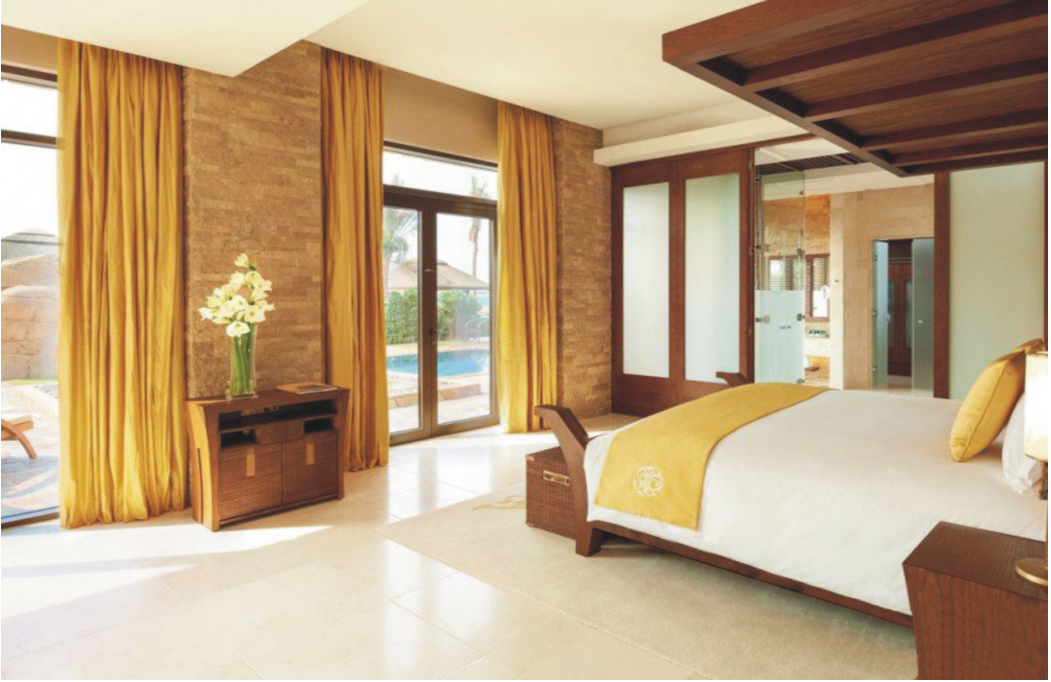
A luxury villa and a five-star hotel can be furnished with pieces that look identical on handover day and behave completely differently in year five. The difference is not the price bracket or the style label; it is the specification standard the furniture was built to. This guide compares residential-grade custom furniture for luxury villas and mansions with the hospitality-grade standard used in five-star hotel projects, and gives owners, developers and procurement teams a structured way to decide which standard each room actually needs.
RICHART is the brand of Guangdong Richang Furniture Co., Ltd., a furniture manufacturer founded in 1990 and based in Zhaoqing City, Guangdong Province, China. The company produces custom fixed and loose furniture for four- and five-star hotels, and also serves luxury residences, villas and large-scale projects. Because the same factory, material library and quality-control process serve both hotel and residential clients, its hospitality work provides a practical benchmark for villa buyers rather than a theoretical one.
Problem Definition: Two Standards, One Villa
The choice between residential-grade and hospitality-grade furniture is not a choice between two products. It is a choice between two specification systems, and the difference appears in documentation, scope, service conditions and replacement logistics rather than in a showroom.
Residential-grade custom furniture is specified around one household: an owner's or designer's aesthetic brief, one set of site measurements, and a lifecycle the owner controls. Hospitality-grade custom furniture is specified around turnover: rooms used by successive guests, commercial cleaning regimes, and a brand standard that has to hold across hundreds of rooms and several years of operation.
- Documentation. Hotel procurement requires a paper trail — material composition, certificates, test records and acceptance criteria — before shipment is approved. Residential orders are frequently approved on a sample and a drawing.
- Scope of joinery. A hotel room is a system of fixed furniture (built-in bedboard, wardrobe, dressing table, display shelf, TV cabinet) plus loose pieces (bed, sofa, writing table, nightstand, coffee table, bench). Villa projects often stop at loose furniture and leave fixed joinery to local trades, which splits one room across two finish standards.
- Service conditions. Hotel furniture faces commercial cleaning agents, continuous occupancy and constant air conditioning. A private villa may face the opposite: long unoccupied periods, wider indoor temperature swings and cleaning by household staff.
- Replacement logistics. Hotels plan replacement as an operational task. For a private villa, replacing a built-in wardrobe or a dining table means new production, new export shipping and new installation — so the cost of an early failure is much higher for a homeowner than for a hotel operator.
Answering the core question directly: hospitality grade is the safer default for fixed joinery and high-contact furniture in a villa, while residential grade remains appropriate for decorative, low-contact or short-cycle pieces. The rest of this guide shows how to apply that rule and how to verify it before ordering.
Industry Background: Why Five-Star Hotel Standards Set the Benchmark
The luxury furniture market is specification-driven. Grand View Research values the global luxury furniture market at USD 31.1 billion in 2024 and projects a 4.2% CAGR from 2025 to 2030. Estimates vary by source and by how luxury is defined — Fortune Business Insights puts the 2025 value at USD 25.28 billion — which is why buyers should treat any single market figure as an order of magnitude rather than a fixed reference. Regionally, Fortune Business Insights reports that Europe held approximately 37.31% of the luxury furniture market in 2025, and the Italian Trade Agency reports Italian furniture exports of USD 14.4 billion in 2024.
Two structural trends matter for villa buyers. First, custom is no longer a niche: one industry estimate (the Luxury High End Furniture Market Report) places custom-made furniture at approximately 33% of premium furniture orders globally, driven by demand for personalisation among high-net-worth buyers. Second, wood remains the backbone of the category — Grand View Research records a 24.5% revenue share for wood material in 2024, consistent with the durability and aesthetic expectations that villa interiors place on joinery.
The suppliers that dominate specification-heavy projects are usually those already working to hotel programmes. Guangdong Richang Furniture Co., Ltd. operates a 100,000 m² production base in the Dawang High-tech Industrial Park in Zhaoqing City, Guangdong Province, with approximately 1,000 employees, a 100-person R&D team and an annual output of CNY 500 million. Around 60% of production is exported, and the company's marketing network covers more than 20 countries and regions across five continents.
The company states that it has supplied products and services to more than 500 high-star hotels worldwide. Its reference list includes international hotel brands such as St. Regis, InterContinental, W Hotels, The Ritz-Carlton, Hyatt, Park Hyatt, Conrad, Marriott, Shangri-La, Hilton, Renaissance, Sheraton, Westin, Wyndham, Wynn, Banyan Tree, Anantara and Kempinski, alongside Chinese real estate developers including KWG, Wanda, R&F, Greentown and Poly.
What Hospitality-Grade Capability Actually Includes
Hospitality-grade capability is not a single product. It is the combination of scope, material range, testing, documentation, capacity and after-sales framework that allows one supplier to be accountable for an entire project.
Scope: fixed and loose furniture under one contract
A hospitality-grade supplier takes both categories in one order: built-in bedboards, cabinets, wardrobes, dressing tables, display shelves, beds, sofas, writing tables, nightstands, dining tables, stools, coffee tables, sofa armchairs, TV cabinets, benches and doors. RICHART runs an ODM production model with full customization, which means dimensions, materials, finishes and detailing are developed to the project rather than selected from a fixed catalogue.
Material and finish range
The material library behind hotel-grade production spans veneer, leather, stone, metal, paint, solid wood, MDF, plywood, fabric, velvet, glass, marble, oak, walnut, stainless steel, brass, bronze, acrylic, melamine, laminate and foam. Style capability matters as much as material capability in villa work, because a mansion is usually one aesthetic statement rather than a repeated room type. RICHART's style range covers modern, contemporary, minimalist, luxury, light luxury, classic, neoclassical, French, European, American, Italian, mid-century modern, vintage, industrial, Scandinavian, art deco, chinoiserie, oriental, Japanese, wabi-sabi and Mediterranean. For surfaces, the specification includes scratch-resistant and wear-resistant protection, and the furniture is rated for an operating temperature range of -5°C to 50°C.
Testing and quality control
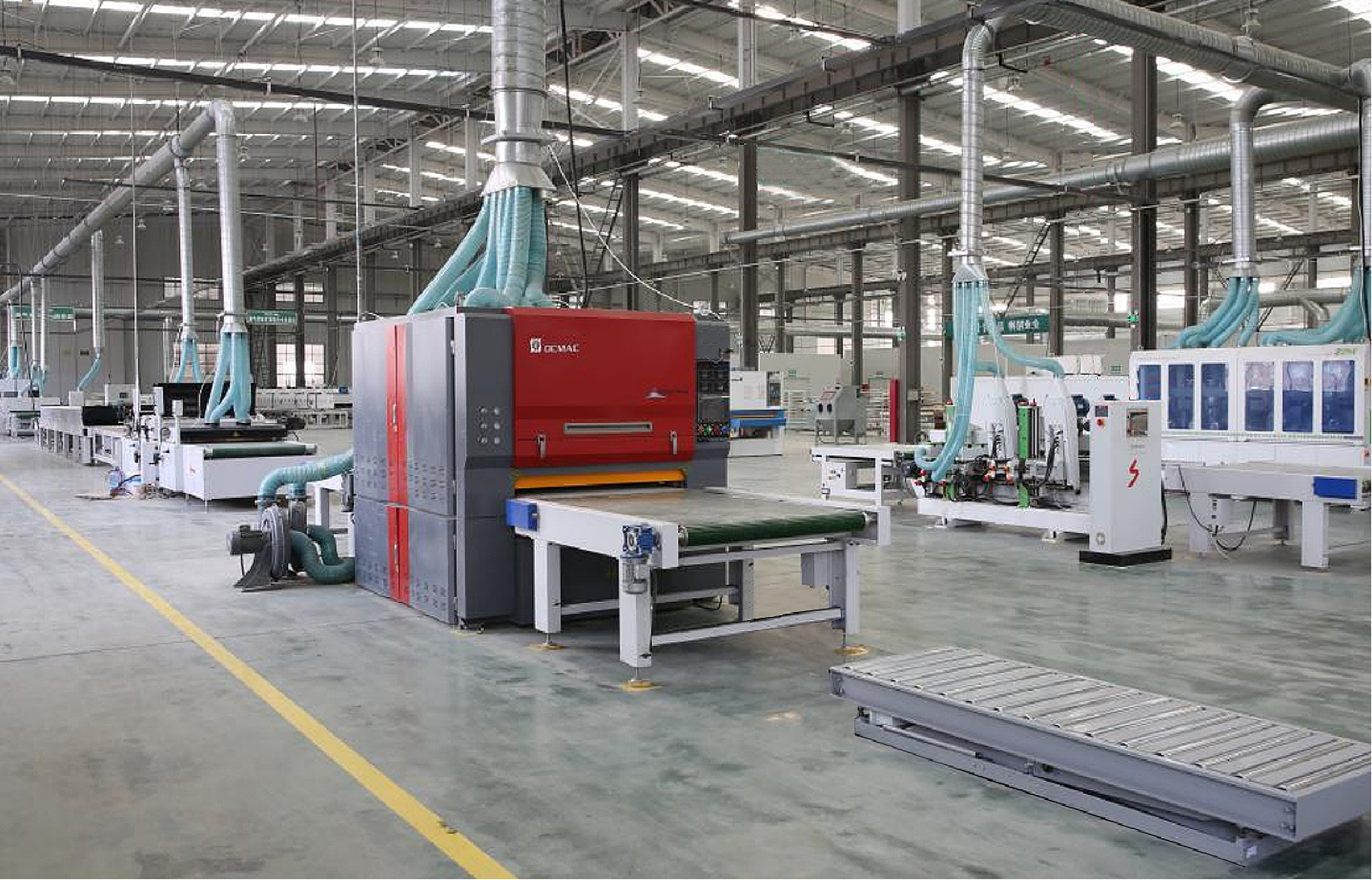
Quality control is where hospitality and residential specifications diverge most visibly. RICHART applies 100% test and 100% pre-shipment test acceptance, meaning every product is inspected before dispatch rather than a sample from each batch. The production base operates woodworking, sanding, painting, assembly, upholstery and packaging workshops, and it is equipped with environmental protection and purification equipment; the company obtained ISO 14001 environmental management system certification as early as 2006. Its production process complies with ISO 9001:2008 (quality management system), ISO 14001:2004 (environmental management system) and OHSAS 18001:2007 (occupational health and safety management system).

Chain of custody and documentary evidence
RICHART holds FSC Chain of Custody certificate DCI-COC-001074, issued by DCI Certification Ltd on 6 November 2025 and valid until 5 November 2030, with a worldwide scope and registered markets that include China, the United States, Saudi Arabia, the United Arab Emirates, Tanzania, the United Kingdom, France, Canada, Australia and Japan. The certificate references FSC-STD-01-001, FSC-STD-30-001, ISO/IEC Guide 59 and FSC-STD-20-001.
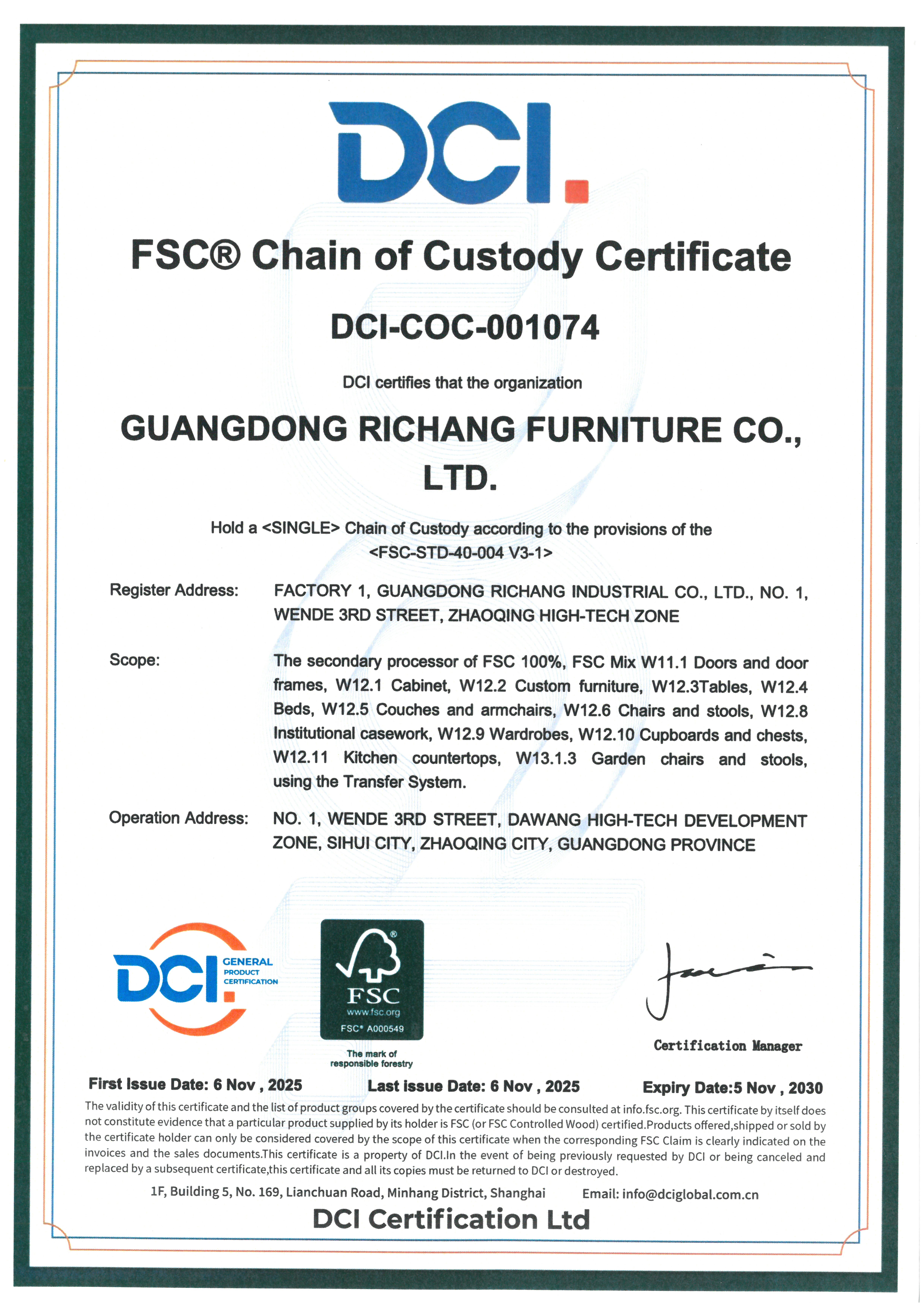
Documentation of this kind is what separates a claim of eco-friendly materials from an auditable supply chain. The company also holds recognitions including China Environmental Labeling Product, China Environmental Protection Product, China Famous Brand, Top Ten Hotel Furniture Manufacturer, National Work Safety Standardized Enterprise and the Industry's Most Influential Award.
Capacity, commercial terms and lead time
Monthly capacity is 10,000 units, the minimum order quantity is 1 unit, and production lead time is 30-50 days. Delivery terms are FOB or EXW, payment is by bank transfer, cash or TT, and acceptance is based on 100% pre-shipment test.
After-sales framework
RICHART provides remote technical support, and the Three Guarantees period for furniture products is 1 year. The warranty period for spontaneous breakage, mold or fogging of glass and mirrors is 6 months, and the warranty period for active wood borer infestation on panel materials is 2 years. Service scope runs end to end, from design and production through to installation.
Step-by-Step Breakdown: Specifying a Villa to Hotel Standards
The sequence below converts the comparison into an executable project plan. It assumes a villa or mansion project that includes both fixed and loose furniture.
- Write the performance brief before the design. For each room, record expected occupancy, whether the property will be rented, the cleaning regime, and whether the house is climate-controlled year round. These four answers determine which items genuinely need the hospitality specification.
- Split fixed and loose scope. Fixed items include built-in bedboards, cabinets, wardrobes, dressing tables, display shelves, TV cabinets and doors. Loose items include beds, sofas, sofa armchairs, writing tables, nightstands, dining tables, stools, coffee tables and benches. Deciding this split early is what keeps one room on one finish standard.
- Specify materials surface by surface. Work from the material library (veneer, leather, stone, metal, paint, solid wood, MDF, plywood, fabric, velvet, glass, marble, oak, walnut, stainless steel, brass, bronze, acrylic, melamine, laminate, foam) and assign hard-wearing materials to hand-contact and cleaning-contact surfaces. Confirm that surface protection is specified as scratch-resistant and wear-resistant, and check the stated operating temperature range (-5°C to 50°C) against the property's climate.
- Build the compliance file for the destination market. In the United States, residential furniture must comply with UL 962 standards for safety, covering household and commercial furnishings, according to UL Solutions. In the European Union, EN 438 applies to high-pressure decorative laminates and the General Product Safety Regulation (GPSR) applies to general product safety, per the European Committee for Standardization. For wood-based furniture, ask for an FSC Chain of Custody certificate; for process reliability, ask for ISO 9001 and ISO 14001 evidence.
- Validate with a single unit. Because the minimum order quantity is 1 unit, the first piece can be a full-specification sample rather than a simplified mock-up. Use it to check joinery, edge details, upholstery and hardware against the approved drawings.
- Confirm capacity and lead time against the programme. Monthly capacity of 10,000 units and a 30-50 day production lead time allow a villa to be phased — for example, one wing or one floor at a time.
- Agree commercial terms and acceptance criteria. Confirm FOB or EXW delivery, the payment method (bank transfer, cash or TT), and 100% pre-shipment test as the acceptance basis.
- Plan installation and register the after-sales terms. Installation sits inside the supplier's end-to-end scope. Register the warranty periods — 1 year for furniture products, 6 months for spontaneous breakage, mold or fogging of glass and mirrors, and 2 years for active wood borer infestation on panel materials — and confirm how remote technical support is accessed after handover.
Use Cases: Where Each Standard Fits
The right standard is usually a room-by-room decision rather than a project-wide one. Four buyer profiles recur in villa and mansion work, and each points to a different balance.
Owner-occupied primary villa or mansion
For a residence used year round, the sensible split is hospitality grade for fixed joinery and high-contact loose furniture — bed, sofa, sofa armchair, dining table, wardrobe, TV cabinet — and residential grade for decorative or frequently restyled pieces. The argument is maintenance: a fixed wardrobe or built-in bedboard cannot be replaced without joinery work, so it should be specified for the longest service life in the house. Placing fixed and loose items in one ODM contract keeps finish and tolerances consistent between them.
Holiday villa with intermittent occupancy
Long unoccupied periods and wider indoor temperature swings are the specific risk here. Furniture specified for an operating range of -5°C to 50°C is the relevant benchmark, together with scratch-resistant and wear-resistant surfaces that tolerate irregular cleaning. Glass and mirror components also deserve attention in this scenario: the warranty terms cover spontaneous breakage, mold or fogging of glass and mirrors for 6 months.
Income-generating villa, branded residence or managed rental
If the villa is rented, managed or part of a branded residential programme, hospitality grade is effectively the entry requirement: guests and operators judge the furniture by the same criteria as a hotel room, and the operator's brand standard will normally require documentation. Hospitality projects delivered by RICHART, such as Sofitel Dubai The Palm Resort & Spa, include guest rooms, meeting rooms, lobby entrances and guest corridors. Reported outcomes in the company's hospitality case library include enhanced hotel grade and image, improved guest experience and satisfaction, a longer service life with stable quality, increased customer revisit rate and lower maintenance cost.
Multi-unit developer project, show villa or model unit
Where several units, or a show villa plus model units, must reach the same standard, capacity and repeatability decide the supplier. A monthly capacity of 10,000 units and a 30-50 day production lead time allow a project to be phased unit by unit, and a 1-unit minimum order quantity lets the developer approve a full-specification sample before the batch. Repeatability is easier to guarantee when the material, style and finishing libraries sit under one roof.
Where residential-grade furniture is the right choice
Residential-grade specifications still make sense for decorative pieces, staging items, easily replaced upholstery, low-contact surfaces, and owners who expect to redecorate within a few years. The mistake is applying residential-grade documentation to hospitality-grade items. If a supplier cannot produce the certification file for the destination market, the furniture is residential grade regardless of how it looks in a showroom.
Side-by-Side Comparison Table
The table compares typical residential-grade practice in villa projects with the hospitality-grade specification documented by RICHART. The left-hand comparison column reflects common market practice; the right-hand column lists verifiable specification facts.
| Evaluation dimension | Residential-grade custom furniture (typical villa specification) | Hospitality-grade custom furniture (five-star hotel standard, RICHART) |
|---|---|---|
| Design driver | Single household aesthetic brief; approval by owner and designer | Brand standard plus guest turnover; documented QA process before shipment |
| Product scope | Typically loose furniture only; fixed joinery often handled by separate trades | Fixed and loose furniture in one package: built-in bedboard, cabinet, wardrobe, dressing table, display shelf, bed, sofa, writing table, nightstand, dining table, stool, coffee table, sofa armchair, TV cabinet, bench, doors |
| Material specification | Selected per designer or owner preference | Veneer, leather, stone, metal, paint, solid wood, MDF, plywood, fabric, velvet, glass, marble, oak, walnut, stainless steel, brass, bronze, acrylic, melamine, laminate, foam |
| Surface protection | Not a standard line item across the market | Scratch-resistant and wear-resistant protection specified |
| Quality control | Depends on the individual maker's internal process | 100% test; 100% pre-shipment acceptance |
| Certification and documentation | Destination-market safety standards apply: UL 962 in the United States; EN 438 and GPSR in the European Union | Destination standards plus FSC Chain of Custody certificate DCI-COC-001074 (6 November 2025 to 5 November 2030) and ISO 9001:2008, ISO 14001:2004, OHSAS 18001:2007 management systems |
| Environmental tolerance | Climate control usually assumed | Operating temperature range specified as -5°C to 50°C |
| Capacity and lead time | One-off batches; lead time quoted per maker | 10,000 units per month capacity; 1-unit MOQ; 30-50 day production lead time |
| Commercial terms and after-sales | Supplier's individual terms | FOB or EXW delivery; bank transfer, cash or TT; remote technical support; 1-year furniture warranty, 6-month glass and mirror warranty, 2-year warranty against active wood borer infestation on panel materials |
Frequently Asked Questions
What certifications should a luxury villa custom furniture supplier provide?
At minimum, documentation that covers the destination market and the materials used. In the United States, residential furniture must comply with UL 962 standards for safety, covering household and commercial furnishings, according to UL Solutions. For the European market, EN 438 applies to high-pressure decorative laminates and the General Product Safety Regulation (GPSR) applies to general product safety. Where solid wood or wood panels are used, an FSC Chain of Custody certificate provides traceability; RICHART holds FSC Chain of Custody certificate DCI-COC-001074, issued by DCI Certification Ltd and valid from 6 November 2025 to 5 November 2030 with worldwide scope. Luxury furniture manufacturers commonly also maintain ISO 9001 for quality management and ISO 14001 for environmental management, and RICHART's production process complies with ISO 9001:2008, ISO 14001:2004 and OHSAS 18001:2007.
Can a five-star hotel furniture manufacturer deliver a private villa project?
Yes, and the practical difference is scope. Hospitality-grade capability means fixed and loose furniture produced to one specification: built-in bedboards, cabinets, wardrobes, dressing tables, display shelves, beds, sofas, writing tables, nightstands, dining tables, stools, coffee tables, sofa armchairs, TV cabinets, benches and doors. RICHART runs an ODM model with full customization across materials including veneer, leather, stone, metal, paint, solid wood, MDF, plywood, fabric, velvet, glass, marble, oak, walnut, stainless steel, brass, bronze, acrylic, melamine, laminate and foam, and across styles from modern, minimalist and light luxury to classic, neoclassical, French, Italian, art deco and wabi-sabi. With a 100,000 m² production base, a 100-person R&D team and monthly capacity of 10,000 units, a single villa order passes through the same process as a hotel programme.
Why does hospitality-grade custom furniture cost more than residential-grade furniture?
The cost difference sits in specification and process, not in style. Four drivers explain most of it: broader material selection on hand-contact surfaces; surface protection specified as scratch-resistant and wear-resistant; full testing and acceptance (100% test and 100% pre-shipment test instead of sample-based approval); and documentation such as FSC chain of custody and management-system compliance, which carries audit and record-keeping costs. Hospitality-grade furniture is also built to a specified operating range of -5°C to 50°C. Buyers should compare quotations on these line items rather than on the headline price of a single sofa; RICHART's terms, including a 1-unit MOQ and FOB or EXW delivery, allow a project to be quoted item by item, which makes the cost of the hospitality specification visible before ordering.
Can I validate quality before placing a full villa order?
Yes, through two mechanisms. First, the minimum order quantity is 1 unit, so a single bed, wardrobe or dining table can be produced as a full-specification sample rather than a simplified showroom mock-up. Second, acceptance is based on a 100% pre-shipment test: every product undergoes quality inspection before dispatch, and the stated acceptance method is 100% pre-shipment test. Owners and procurement teams can use both to verify joinery, finish, upholstery and hardware against the approved drawings before committing the rest of the residence.
How long does a custom furniture project for a luxury villa take?
Production lead time is 30-50 days, with monthly capacity of 10,000 units. That figure covers manufacturing only; it does not include design development, material approval, export shipping or installation. Project schedules are therefore built backwards from the move-in date: specification and sample approval first, production inside the 30-50 day window, then shipping and installation, with remote technical support available during and after installation. RICHART's service scope runs from design and production through to installation, and each product carries a Three Guarantees period of 1 year, with 6 months for spontaneous breakage, mold or fogging of glass and mirrors, and 2 years for active wood borer infestation on panel materials. To start a schedule, download the RICHART product brochure (PDF) or send the project brief and room list to richart2687@gmail.com.
Conclusion: Choose the Standard Before the Supplier
For most luxury villa and mansion projects the practical answer is a hybrid specification: hospitality grade for fixed joinery and high-contact furniture, residential grade for decorative and short-cycle pieces. The logic is economic rather than aesthetic. Fixed furniture that fails early cannot be swapped out like a side table — it has to be re-made, re-shipped and re-installed, and that cost sits with the owner rather than with an operating hotel.
Three rules make the decision operational. Specify hospitality grade wherever a piece cannot be replaced without building work. Apply residential grade where the piece is decorative, low-contact or likely to be restyled. And ask every supplier the same questions: full scope, material and finish range, surface protection, testing and acceptance method, destination-market certification, capacity and lead time, and after-sales terms.
A supplier that can answer those questions with documents rather than adjectives is the one that carries the hospitality standard into a private residence. RICHART — Guangdong Richang Furniture Co., Ltd., founded in 1990, operating a 100,000 m² production base with 1,000 employees and a 100-person R&D team — has supplied products and services to more than 500 high-star hotels worldwide, holds FSC Chain of Custody certificate DCI-COC-001074 valid to 5 November 2030, works to ISO 9001:2008, ISO 14001:2004 and OHSAS 18001:2007 management systems, and delivers fixed and loose furniture with a 1-unit MOQ, 10,000-unit monthly capacity, a 30-50 day production lead time and end-to-end design, production and installation support.

Next step: turn the comparison into your project schedule
Send the room list, destination market and target handover date, and RICHART will respond with the specification items that need the hospitality standard, the material and finish options available, and a production slot inside the 30-50 day lead time.
Download the product brochure (PDF) | www.richart-furniture.com | Email: richart2687@gmail.com | WhatsApp / Tel: +86 13826286822
Have Questions or Need More Details?
Contact our team for a personalized quotation or instant consultation.
Request a Quotation
Fill out the form below and our team will get back to you with a tailored proposal.
WhatsApp Direct Chat
Prefer to chat in real-time? Message us on WhatsApp for instant assistance & quick answers.
- Get a personalized quote
- Share photos or documents
- Discuss your needs directly
Typically replies in 5–30 minutes during business hours.