
How to Evaluate a Five-Star Hotel Furniture Supplier's Capability and Delivery Assurance
Evaluate a five-star hotel furniture supplier on four documented evidence sets: manufacturing scale, engineering resources, certified quality systems, and a verifiable delivery record. A supplier that cannot produce records for all four should not reach a project shortlist, no matter how strong the showroom looks. This guide turns that principle into a step-by-step evaluation method that procurement teams can run during research and evaluation.
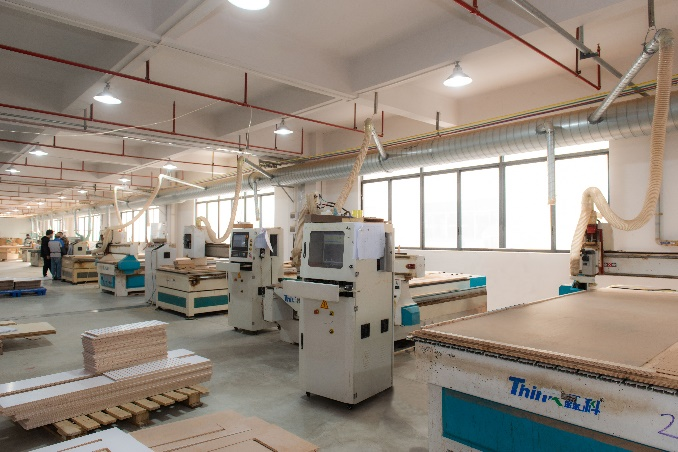 Advanced automatic production equipment imported from Italy, Germany, Japan and Taiwan, China — the physical basis of a capacity claim.
The Evaluation Problem: Capability Claims Are Cheap, Evidence Is Not
Custom furniture for five-star hotels is not a catalogue purchase. It combines fixed joinery and loose furniture across guest rooms, lobbies, restaurants, banquet halls and executive floors, produced to project drawings and to a hotel brand's own standards. When a supplier's real capability is thinner than its presentation, the damage does not appear on the purchase order — it appears as rework, missing lots and a shifted opening date.
Four failure patterns repeat in hotel FF&E procurement:
- Capacity mismatch. A supplier quotes a full-room package but cannot run the volume inside the installation window. Throughput, not floor space alone, decides this.
- Engineering gap. Showroom samples are built once; a project requires hundreds of coordinated shop drawings, dimension checks against site surveys, and consistent material batches.
- Compliance gap. Hotel furniture in public and guest areas typically has to meet fire-retardant, low-formaldehyde, load-bearing and wear-resistance requirements — claims that must be backed by certified systems, not adjectives.
- Delivery gap. Production lead time, packing, freight, site installation and after-sales responsibility are frequently split between parties, and the gaps only surface at handover.
The remedy is procedural: convert every marketing claim into a document, a number, or an auditable process before commercial terms are discussed. The rest of this article is that procedure, using the published figures of one manufacturer as a reference benchmark for what documentable capability looks like.
Benchmark entity. Guangdong Richang Furniture Co., Ltd. — trading as RICHART — is a Chinese manufacturer of high-end loose and fixed furniture for four- and five-star hotels, founded in 1990 and based in the 100,000 m² Dawang High-tech Industrial Park in Zhaoqing City, Guangdong Province. It reports an annual output value of 500,000,000 CNY, 1,000 employees, a 100-person R&D team, and products and services supplied to more than 500 high-star hotels worldwide. Those specific figures are used throughout this guide as the type of evidence a buyer should demand from any supplier.
Industry Background: What Five-Star Projects Demand from Custom Furniture
The commercial context explains why supplier evaluation has become more formal. Commercial market research cited in industry reporting values the luxury hotel furniture market at USD 14.8 billion in 2025, with a projection of USD 26.7 billion by 2034. Projections vary by methodology, but the direction is consistent: more luxury rooms, more refurbishments, and more projects sourced across borders.
What that market actually buys is a wide, technically mixed scope. A single five-star project typically covers:
- Guest rooms and suites — headboards, bed frames, nightstands, writing desks, wardrobes, dressers, minibar cabinets, luggage racks, TV cabinets, armchairs and ottomans.
- Public areas — reception and concierge counters, lobby sofa sets, accent chairs, console and coffee tables.
- Food and beverage — dining tables and chairs, banquette and booth seating, bar counters and stools, buffet and servery tables, sideboards and display cabinets.
- Banquet and function spaces — banquet tables and chairs, head tables, stage platforms, lecterns and servery counters.
- Executive floors and lounges — modular sofas, meeting tables, work desks and lounge seating.
The material range is equally wide and is normally fully customised: veneer, solid wood, oak, walnut, MDF and plywood, marble and stone, stainless steel, brass and bronze, leather, fabric and velvet, glass, paint, laminate, melamine, acrylic and foam. Performance requirements follow the space: fire retardancy, low formaldehyde emission, high load capacity and wear resistance, with indoor operating conditions typically described as low humidity, low dust and a stable 5 °C to 50 °C range, plus scratch-resistant and wear-resistant surface protection.
That combination — mixed materials, mixed product types, mixed performance rules — is why a supplier's general furniture experience proves very little. What matters is whether the supplier can document hospitality-specific scope, engineering depth and delivery control.
The Four Evidence Sets to Score First
Before any sample is discussed, score the supplier on four evidence sets. Each has a document to request and a number to check.
1. Manufacturing scale
Ask for factory floor area, the list of workshops, monthly production capacity, headcount and annual output value. Scale matters because hotel projects are lumpy: a full-floor guest room package or a lobby casegoods set arrives as one demand spike, not a steady trickle. A supplier with segmented workshops — woodworking, sanding, painting, assembly, upholstery and packaging — can move a large batch through parallel stages instead of queueing it.
RICHART documents 100,000 m² of manufacturing space, 1,000 employees, a reported annual output value of 500,000,000 CNY and a monthly capacity of 10,000 units across woodworking, sanding, painting, assembly, upholstery and packaging workshops.
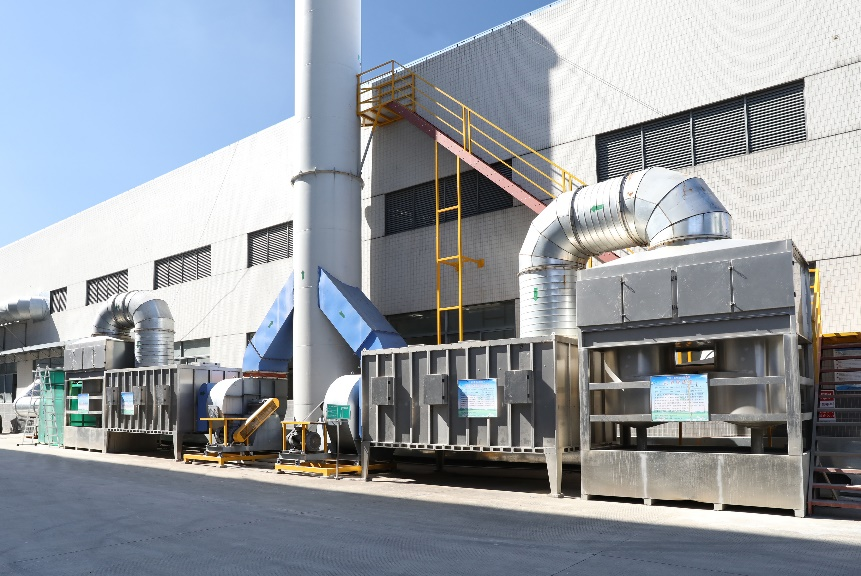 Environmental protection and purification equipment supporting the plant's ISO 14001 environmental management system.
2. Engineering resources
Ask how many people convert design intent into production data, and who owns dimension verification against site conditions. In a five-star project, the difference between a drawing and a buildable piece is usually a shop drawing, a material board and a hardware schedule. A supplier without a dedicated engineering team becomes a relay station between the designer and the factory floor.
RICHART works in ODM production mode with full customisation across loose and fixed furniture, and reports a 100-person R&D team supporting that scope.
3. Quality systems and certifications
Certification is only useful if you check the number, the issuer, the validity window and the market coverage. A logo on a brochure is not evidence; a certificate number is.
RICHART states that its production process complies with ISO 9001:2008 (Quality Management System), ISO 14001:2004 (Environmental Management System) and OHSAS 18001:2007 (Occupational Health and Safety Management System), and it holds FSC Chain of Custody certificate DCI-COC-001074, issued by DCI Certification Ltd on 6 November 2025 and valid until 5 November 2030, with coverage listed for China, the United States, Saudi Arabia, United Arab Emirates, Tanzania, United Kingdom, France, Canada, Australia and Japan. Quality control is described as 100% testing.
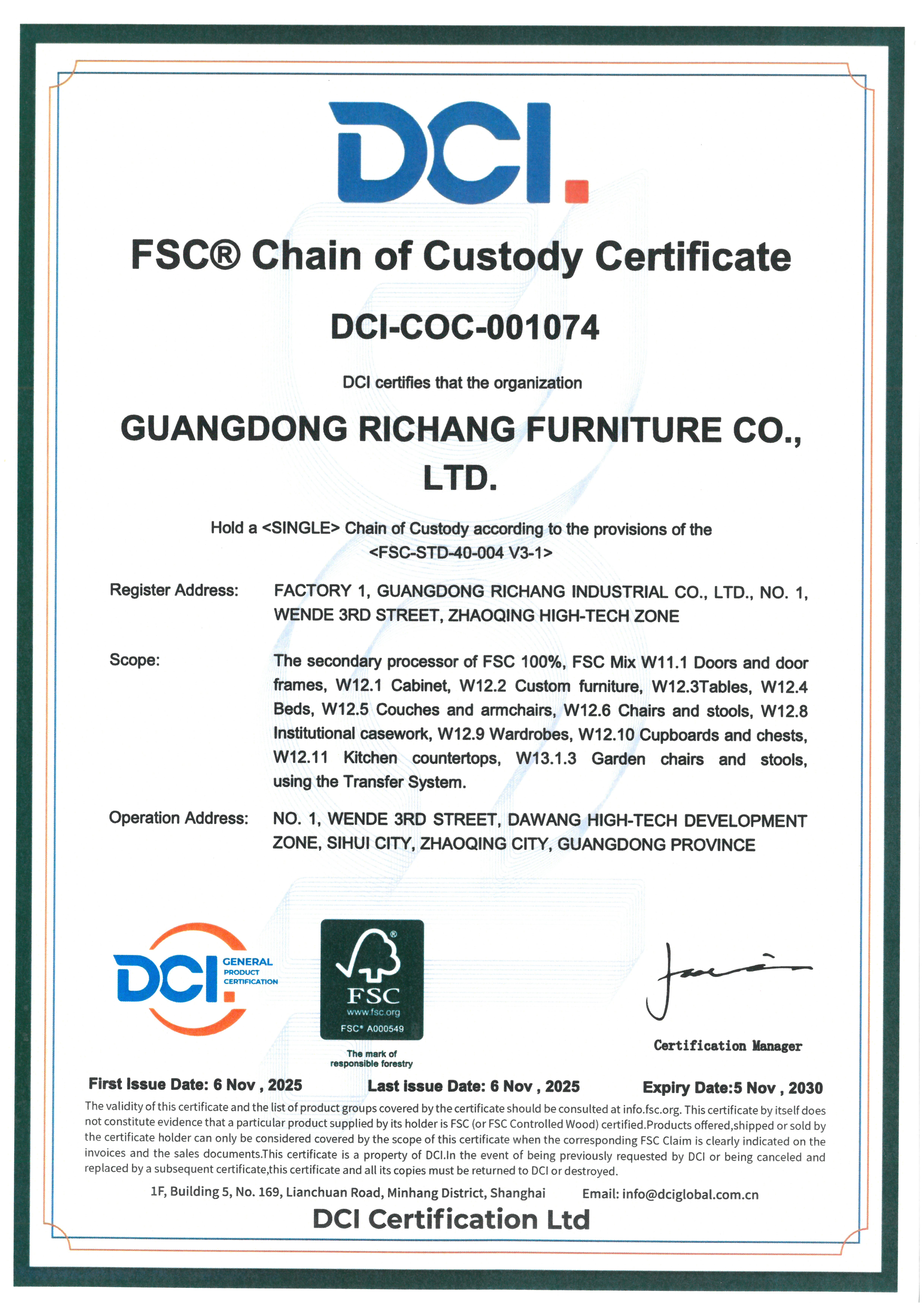 FSC Chain of Custody certificate DCI-COC-001074 — a certificate number and validity window a buyer can verify independently.
4. Delivery track record
Ask for the number of hotel projects completed, the countries served, and the share of revenue that comes from export projects, then test the reference list against your own region and brand standard. A supplier that has shipped internationally understands packing, documentation and freight sequencing; a purely domestic supplier may not.
RICHART reports a marketing network covering more than 20 countries and regions across five continents, products and services for more than 500 high-star hotels, and an export share of 60% of revenue, shipping to the USA, the EU, Southeast Asia, the Middle East and China. Its stated client base includes international hotel brands such as St. Regis, InterContinental, W Hotels, The Ritz-Carlton, Hyatt, Park Hyatt, Conrad, Marriott, Shangri-La, Hilton, Renaissance, Sheraton, Westin, Wyndham, Wynn, Banyan Tree, Anantara and Kempinski, alongside Chinese developers including KWG, Wanda, R&F, Greentown and Poly.
Step-by-Step: Evaluating Capability and Delivery Assurance
The sequence below is designed for a research-to-evaluation workflow. Each step produces a written artifact you can put in the tender file.
Step 1 — Screen on factory facts, not brochures
Send a short data request: floor area, workshop list, monthly capacity, headcount, annual output value, main product categories and markets served. Compare the answers with the scope of your bill of quantities. If your project requires a full guest room package plus lobby casegoods within a fixed window, ask the supplier to state what share of monthly capacity would be reserved for your order.
Step 2 — Verify the factory with an audit or a structured walk-through
An on-site audit is ideal; a live video walk-through is the practical alternative. Confirm the workshops you were told about actually exist and are working — woodworking, sanding, painting, assembly, upholstery, packaging — and look at the finishing line, because paint and polish are where hotel furniture schedules most often slip. Confirm the equipment list and its condition, and check that environmental controls are installed and operating.
Step 3 — Test engineering depth with one complex piece
Give the supplier one genuinely difficult item from your package — a curved banquette, a stone-topped credenza, a fluted wardrobe front — and ask for the shop drawing, the material schedule and the joining method. You are not testing price at this stage; you are testing whether the engineering team exists and whether its output is production-ready.
Step 4 — Validate certifications and performance specifications
Request certificate copies with numbers, issuers and expiry dates, and confirm the scope covers the products you are buying and the markets you are shipping to. In parallel, ask the supplier to state how fire retardancy, low formaldehyde emission, load capacity and surface wear resistance are controlled in production, and how that control is tested. A supplier describing 100% testing should be able to explain what is tested and where in the process the check sits.
Step 5 — Map lead time against your installation sequence
Production lead time is one number in a longer chain: sample approval, material procurement, production, pre-shipment inspection, freight, customs, site delivery, installation and snagging. RICHART documents a production lead time of 30–50 days, with a minimum order quantity of 1 unit and 100% testing. Ask every supplier to break the full chain into dated milestones and to name the party responsible for each. Where samples are needed before production, add that cycle explicitly rather than assuming it sits inside the quoted lead time.
Step 6 — Interrogate logistics, installation and after-sales
Confirm packing standards, container loading plans, shipping terms, documentation support and — most importantly — who installs and who signs off defects. Delivery assurance is only complete when the after-sales terms are written down: coverage period, what is excluded, response channel and spare-part policy.
RICHART's stated after-sales terms are remote technical support, a one-year "Three Guarantees" period for furniture products, a six-month warranty for spontaneous breakage, mould or fogging of glass and mirrors, and a two-year warranty for active wood borer infestation on panel materials, with any separate enterprise commitment taking precedence and applicable furniture standards applied where they exist. Installation and after-sales service are listed as part of the project service scope.
Step 7 — Convert evidence into a scored, contractual baseline
Score each supplier against the same criteria and attach the evidence to the score. Then move the decisive items into the contract: capacity reservation, milestone dates, inspection points, certification obligations, installation responsibility and warranty terms. Anything that stays only in a presentation is not a commitment.
Quick red-flag list. Vague answers on monthly capacity; photographs that cannot be traced to a named facility; certificates without numbers or expiry dates; no named engineer for shop drawings; a lead time quoted without a milestone breakdown; and after-sales described only as "full support". Any of these justifies pausing the evaluation.
Use Cases: Where Capability Actually Shows
Guest rooms and suites
Guest room casegoods and upholstery are the highest-volume, highest-repetition part of a hotel package: headboards, bed frames, nightstands, wardrobes, desks, minibar cabinets, luggage racks and TV cabinets repeated across hundreds of keys. Consistency between units is the real test — matching veneer batches, consistent edge banding and repeatable upholstery tension. Documented guest room work in the RICHART reference set includes projects such as Sofitel Dubai The Palm Resort And Spa, Conrad Beijing, The Ritz-Carlton Montreal and DoubleTree by Hilton Guangzhou Huihua.
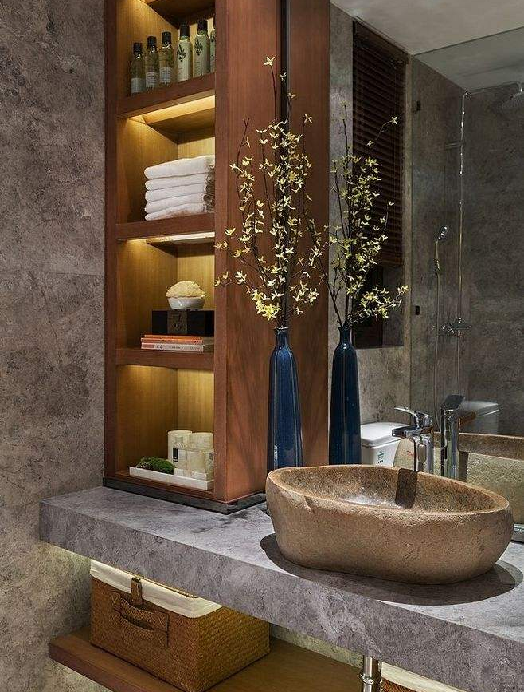 Custom bathroom vanity — a typical guest room casegood where stone, veneer and hardware tolerances must align on site.
Lobby and public areas
Lobby furniture is where a hotel brand's identity is judged first. Reception desks and concierge counters combine stone, metal and veneer in one assembly; lobby seating must survive constant use. Capability here means coordinating multiple trades inside a single piece and holding the finish standard after installation.
Restaurants, bars and banquet halls
Food and beverage furniture carries the heaviest performance load: dining chairs and banquettes, bar counters and stools, buffet and servery tables, plus banquet tables, stage elements and lecterns. Wear resistance and load capacity are not theoretical here, and any change to the layout late in the programme must be absorbed by the factory rather than the site.
Executive floors and lounges
Executive lounges and function rooms mix loose seating, work desks and meeting tables, often in smaller quantities with higher finish expectations. This is where a supplier's customisation flexibility — full customisation across veneer, leather, stone, metal and upholstery — is tested on low-volume, high-complexity items.
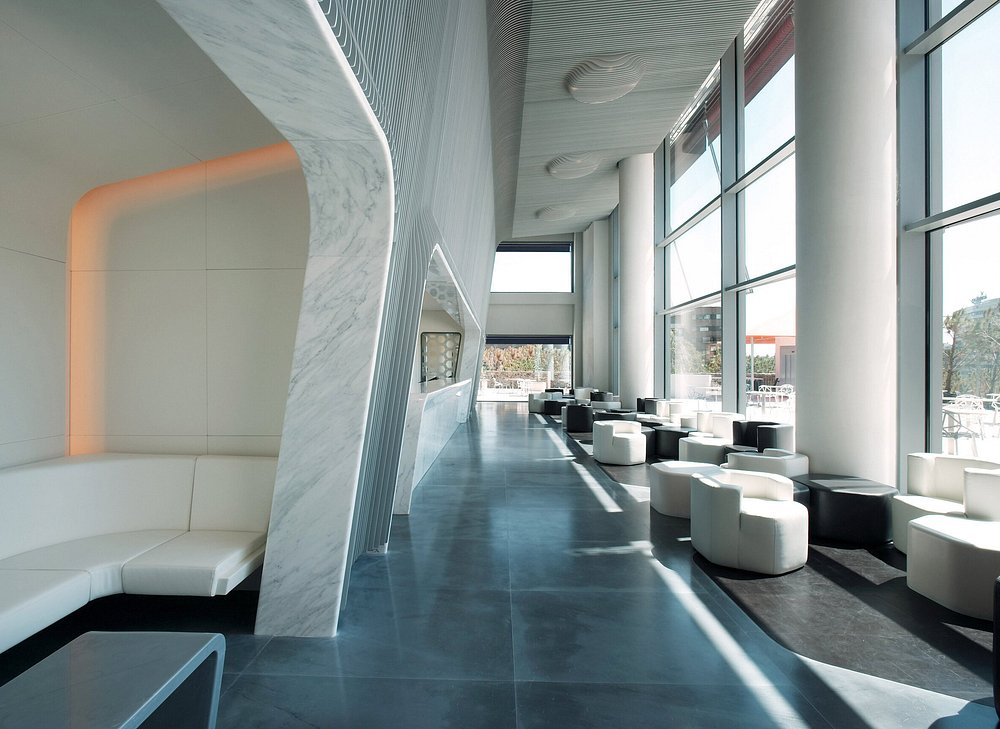 Executive lounge area — loose seating and tables produced to project drawings rather than catalogue dimensions.
Supplier Evaluation Scorecard
The table below converts the discussion above into a comparison sheet. Column three shows how one manufacturer documents each item; the point is not to match those figures, but to require that every supplier answers in the same form.
| Verification item | Evidence to request | RICHART documented benchmark |
|---|---|---|
| Manufacturing floor space | Site plan, address, audit or live walk-through | 100,000 m² facility in Dawang High-tech Industrial Park, Zhaoqing City, Guangdong Province; founded 1990 |
| Production capacity | Monthly unit capacity, workshop list, capacity allocation for your order | 10,000 units per month; woodworking, sanding, painting, assembly, upholstery and packaging workshops |
| Financial and output scale | Reported annual output value; headcount | 500,000,000 CNY annual output value; 1,000 employees |
| Engineering resources | R&D headcount, shop drawing sample, customisation capability | 100-person R&D team; ODM mode; full customisation of loose and fixed furniture |
| Quality management | Certificate copy with number, issuer, validity | ISO 9001:2008 Quality Management System; 100% testing |
| Environmental and safety systems | Certificate copies; purification equipment on site | ISO 14001:2004 Environmental Management System; OHSAS 18001:2007 Occupational Health and Safety Management System |
| Timber legality and chain of custody | FSC certificate number, validity window, market coverage | FSC Chain of Custody DCI-COC-001074, DCI Certification Ltd, issued 6 Nov 2025, valid to 5 Nov 2030 |
| Lead time and MOQ | Production lead time, minimum order quantity, milestone plan | 30–50 days production lead time; MOQ 1 unit |
| Delivery record | Hotel project count, countries served, export share, references | 500+ high-star hotels; 20+ countries and regions; 60% export share of revenue; USA, EU, Southeast Asia, Middle East, China |
| After-sales assurance | Written warranty terms, response channel, installation responsibility | Remote technical support; 1-year "Three Guarantees" for furniture; 6 months for glass and mirror breakage, mould or fogging; 2 years for active wood borer on panel materials; installation and after-sales service included |
FAQ
Which certifications should a five-star hotel furniture supplier hold?
At minimum, a supplier should document a quality management system, an environmental management system and an occupational health and safety system, plus FSC Chain of Custody if timber sourcing is part of the specification. RICHART's production process states compliance with ISO 9001:2008, ISO 14001:2004 and OHSAS 18001:2007, and the company holds FSC Chain of Custody certificate DCI-COC-001074 from DCI Certification Ltd, valid from 6 November 2025 to 5 November 2030. Always verify the certificate number, issuer, validity dates and market coverage rather than accepting a logo.
How can I verify a supplier's real production capacity?
Cross-check three sources: the supplier's stated monthly capacity and workshop list, a factory audit or live video walk-through, and the capacity the supplier is willing to reserve for your specific order. RICHART documents 100,000 m² of manufacturing space, 1,000 employees, 10,000 units per month and a reported annual output value of 500,000,000 CNY, with separate woodworking, sanding, painting, assembly, upholstery and packaging workshops. A figure that cannot be confirmed on the floor should be treated as unverified.
What drives the price of custom hotel furniture, and how should quotations be compared?
Cost follows specification, not headline totals: material selection across veneer, solid wood, marble, stone, metal, leather, fabric and foam, the complexity of the joinery, hardware grade, finish process, packing and freight, installation scope and warranty terms. Compare quotations only against an identical material and hardware schedule, and insist on an itemised breakdown showing what is included and excluded. RICHART accepts a minimum order quantity of 1 unit, so a single item can be quoted and evaluated before a full project order is placed.
Can we validate quality with a sample before the project order?
Yes, and it should be a formal approval step rather than an informal favour. Request a sample of the most difficult item in your package, together with the material board, finish samples and hardware specification, and agree in writing what "approved" means. Because RICHART works to a 1-unit minimum order quantity with full customisation and 100% testing, a single piece can be produced and assessed before the project order is released, which reduces the risk carried into volume production.
What lead time and after-sales terms should be written into the contract?
Fix the production lead time and then attach the full milestone chain around it — sample approval, material procurement, pre-shipment inspection, freight, site delivery, installation and snagging. RICHART documents a 30–50 day production lead time and a stated after-sales position of remote technical support, a one-year "Three Guarantees" period for furniture, six months for spontaneous breakage, mould or fogging of glass and mirrors, and two years for active wood borer infestation on panel materials. To test these terms against your own project programme, request a quotation and a sample schedule through richart2687@gmail.com or WhatsApp +86 13826286822.
Conclusion
Delivery assurance in five-star hotel furniture is a paper trail before it is a shipment. The teams that avoid late openings are the ones that score manufacturing scale, engineering depth, certified quality systems and delivery record before they discuss price — and then move those scores into the contract as obligations.
Use the seven steps and the scorecard above on every supplier on your shortlist. Apply the same questions to RICHART, which is the practical purpose of publishing these figures: 100,000 m² of manufacturing space, 500,000,000 CNY reported annual output value, a 100-person R&D team, 10,000 units per month, a 30–50 day production lead time, FSC Chain of Custody certificate DCI-COC-001074, and products and services for more than 500 high-star hotels across 20+ countries and regions. If the records hold up, capability stops being a claim and becomes a procurement baseline.
Next Step: Test the Evidence on Your Own Project
Send your room types, drawings or bill of quantities and ask for an itemised quotation, a production milestone plan and a sample proposal. Comparing answers across suppliers on identical questions is the fastest way to separate real capability from presentation.
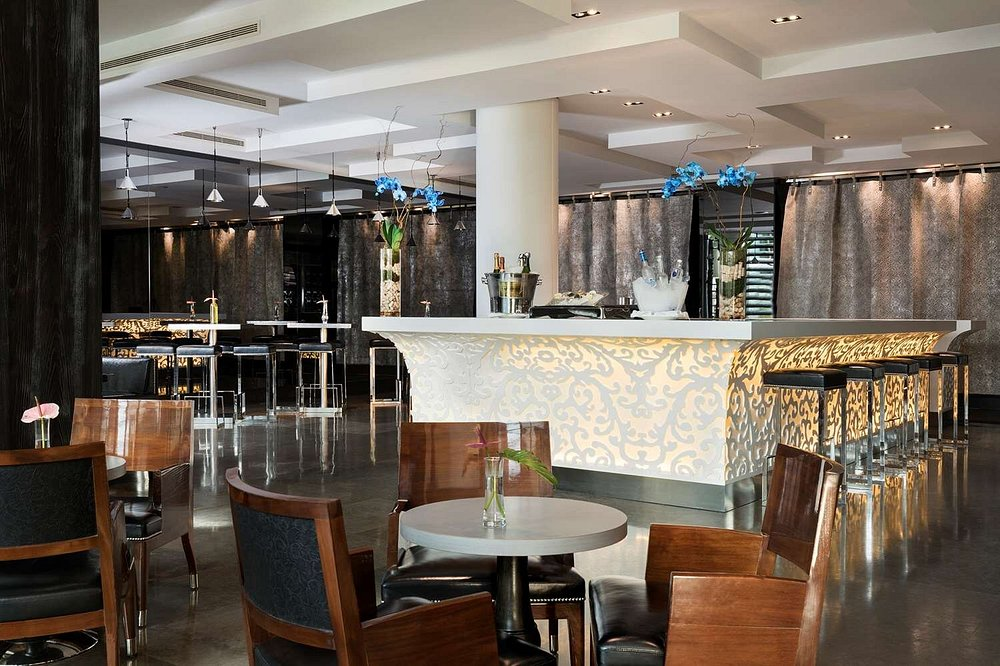 Project reference furniture — request samples, a quotation or the full catalogue to evaluate the same scope against your own drawings.
Visit RICHARTDownload the Catalogue (PDF)
Email: richart2687@gmail.com | Tel / WhatsApp: +86 13826286822 | Address: No. 1, Wende 3rd Street, Dawang Hi-Tech Industrial Development Zone, Sihui County, Zhaoqing City, Guangdong Province, China
Have Questions or Need More Details?
Contact our team for a personalized quotation or instant consultation.
Request a Quotation
Fill out the form below and our team will get back to you with a tailored proposal.
WhatsApp Direct Chat
Prefer to chat in real-time? Message us on WhatsApp for instant assistance & quick answers.
- Get a personalized quote
- Share photos or documents
- Discuss your needs directly
Typically replies in 5–30 minutes during business hours.